


India’s textiles sector saw strong growth in investment and exports in 2025, driven by government incentives and reforms aimed at improving the ease of doing business.
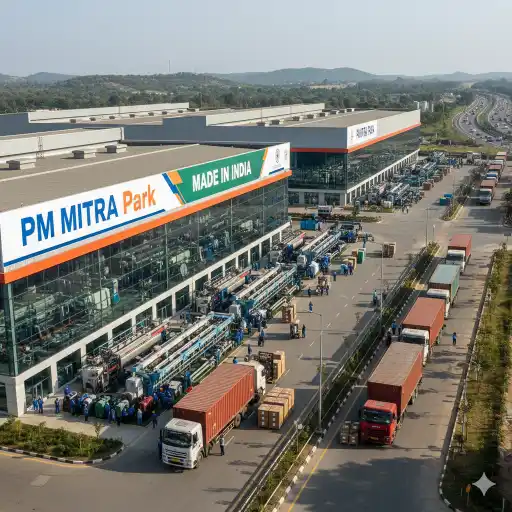
The government approved seven PM Mega Integrated Textile Region and Apparel (PM MITRA) Parks with world-class, plug-and-play infrastructure, allocated Rs 4,445 crore for seven years through 2027-28. The parks are being developed in Tamil Nadu (Virudhnagar), Telangana (Warangal), Gujarat (Navsari), Karnataka (Kalaburagi), Madhya Pradesh (Dhar), Uttar Pradesh (Lucknow), and Maharashtra (Amravati), according to the Ministry of Textiles.
Investment MoUs totaling over Rs 27,434 crore have been signed, with 100% land acquired and handed over to the respective special purpose vehicles. Infrastructure works worth Rs 2,590.99 crore to connect the parks to main roads have commenced in all seven states.
The government also launched the National Technical Textiles Mission (NTTM) with an outlay of Rs 1,480 crore to promote research, market development, education, and exports, aiming to expand technical textile usage in national programmes and strategic sectors. The mission has been extended until March 31, 2026.
Textile and apparel exports, including handicrafts, reached $37.8 billion in 2024-25, up 5% from the previous year, generating a trade surplus of $28.2 billion. Traditional markets such as the US, EU, and UK accounted for 55% of exports, while emerging markets like Bangladesh, UAE, Sri Lanka, Australia, and Canada contributed 20%.
With over 500 districts across 33 states and UTs engaged, the Ministry has set a Vision 2030 goal of $100 billion in exports, focusing on trade partnerships, market diversification, innovation, and sustainability—highlighting India’s Bharatiya Vastra Shakti as a symbol of craftsmanship and global competitiveness.
Recent GST reductions have further boosted the sector. The tax on readymade garments and made-ups up to Rs 2,500/piece is now 5% (previously 5% up to Rs 1,000), man-made fibres and yarns reduced from 18% to 5%, carpets and floor coverings from 12% to 5%, and 36 handicraft items including handwoven carpets and cotton rugs now taxed at 5%. These measures support artisans, enhance rural livelihoods, and protect craft traditions.
In research and development, 168 projects in specialty fibres and applications (including carbon fibre, aramid, alternate materials, composites, and machinery) have been approved with Rs 520 crore funding. Under the production-linked incentive (PLI) scheme, 74 applications with proposed investments of Rs 28,711 crore are expected to generate Rs 2,16,760 crore in turnover and create 2,59,164 jobs, with participants already initiating projects.
The Textiles Trade Promotion (TTP) section, through 11 Export Promotion Councils, continues to strengthen India’s global textile presence. In 2024, India became the 6th largest exporter of textiles and apparel, contributing 8.63% to total exports and 4.1% of global trade.
Cotton remains central to the sector, supporting nearly 6 million farmers and 40–50 million people across the value chain. In 2024–25, the Cotton Corporation of India (CCI) procured 525 lakh quintals (100 lakh bales) under MSP operations, paying Rs 37,450 crore to farmers, covering 38% of arrivals and 34% of national production.
Handloom and craft initiatives have strengthened the ecosystem through market promotion, welfare, and raw material support. Over 300 marketing events were organized, 12 Handloom Producer Companies formed, and six Craft Handloom Villages established (two more underway), linking craft promotion with tourism. Under the Weavers’ MUDRA Scheme, 11,544 artisans accessed credit, and social security coverage expanded to 2.35 lakh beneficiaries.
