


In a standout example of student innovation and frugal engineering, three mechanical engineering students from Bhagwan Mahavir University, Surat — Shivam Maurya, Gurpreet Arora and Ganesh Patil — have developed ‘Garuda’, India’s first driverless AI-powered bike prototype using nearly 50 % scrap materials. The project showcases how young engineers can blend creativity, sustainability and advanced technology to build cutting-edge prototypes without relying on expensive components.
The idea behind Garuda was ambitious from the start. Over the course of about a year, the team invested around ₹1.8 lakh, sourcing discarded metal parts and reusable components to construct much of the bike’s structure and mechanisms. Instead of seeing scrap as a limitation, they used it as a design challenge, demonstrating that innovation doesn’t always need deep pockets — only clear intent and technical skill.
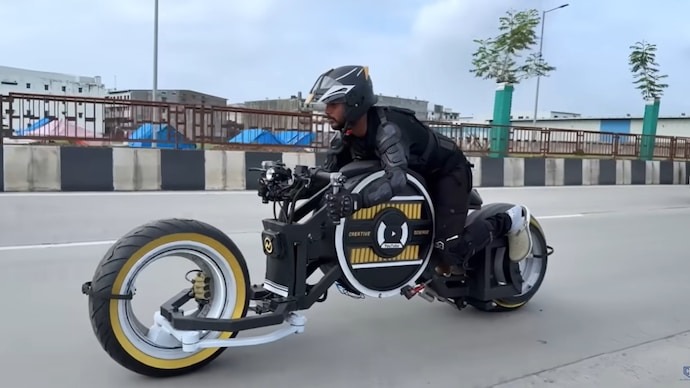
At the core of Garuda is a Raspberry Pi-based system that acts as the bike’s central brain, enabling it to respond to voice commands, regulate speed automatically and even come to a stop without manual input. Innovative safety features, including high-range sensors that detect obstacles and bring the bike to a halt when needed, underline the team’s focus on practical autonomous functions.
Garuda also includes features more common in premium vehicles such as a touchscreen dashboard with GPS navigation, phone connectivity, cameras for real-time video feeds and wireless mobile charging — all assembled into a prototype that already delivers notable performance figures on a lithium-ion battery.
For the trio, Garuda is more than a prototype: it’s a statement about the power of grassroots innovation. By combining artificial intelligence, sustainability and hands-on engineering, they are redefining how smart transportation concepts can be developed in India, inspiring others to push the boundaries of possibility.
