


India and New Zealand have concluded negotiations on a free trade agreement (FTA), aiming to double bilateral trade over the next five years. Bilateral trade between the countries reached $1.3 billion in 2024-25. While talks have concluded, the deal is expected to be signed in 2–3 months after legal review, with implementation taking over six months once passed by the New Zealand Parliament. India’s Cabinet has already approved the agreement.
Prime Minister Narendra Modi highlighted the deal as a historic milestone achieved in just nine months, reflecting strong political will and shared ambition. New Zealand Prime Minister Christopher Luxon described the FTA as significant, noting it would create jobs, increase wages, and expand business opportunities while giving New Zealand exporters better access to India’s 1.4 billion consumers.
Union Home Minister and Minister of Cooperation Amit Shah praised the FTA as a milestone of India’s trade diplomacy. On X, he said the agreement “brings in $20 billion investment and offers lucrative opportunities for Indian innovators, entrepreneurs, farmers, MSMEs, students, and youth, opening new gateways to prosperity.”
Under the FTA, India will reduce tariffs on 95% of New Zealand exports, while New Zealand will remove tariffs on 100% of Indian exports. Additionally, New Zealand has committed $20 billion in investments over 15 years. Experts noted that the tariff asymmetry may benefit New Zealand more in goods trade due to already low tariffs.
The agreement also enhances mobility for Indian students and professionals. Indian students can work at least 20 hours per week during studies and receive extended post-study work opportunities—up to three years for STEM Bachelor’s and Master’s graduates and up to four years for Doctorate holders. A new Temporary Employment Entry (TEE) visa provides up to 5,000 Indian professionals in skilled occupations a three-year stay, covering roles such as AYUSH practitioners, yoga instructors, chefs, music teachers, and sectors like IT, engineering, healthcare, education, and construction.
While Luxon emphasized trade and investment benefits, New Zealand’s Foreign Minister Winston Peters expressed concerns, calling the deal “neither free nor fair,” citing too many concessions on immigration and insufficient gains for New Zealand, particularly in dairy.
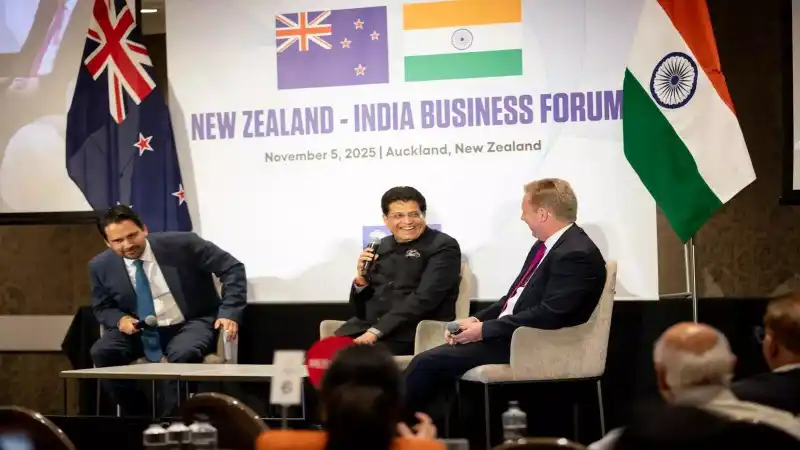
Commerce Minister Piyush Goyal and Commerce Secretary Rajesh Agrawal highlighted that the FTA strengthens India’s export potential, supports labour-intensive growth, and facilitates skilled workforce mobility. The agreement also includes provisions to address non-tariff barriers through regulatory cooperation, streamlined customs, and SPS measures.
The FTA preserves India’s exclusion of dairy products while providing zero-duty access for all other Indian exports to New Zealand. It also offers a quota of 5,000 temporary employment visas and 1,000 work-and-holiday visas, further strengthening people-to-people and professional ties between the countries.
