


The social relevance of cinema has always been a topic of discussion, and with the passing of Sreenivasan, Malayalam cinema has lost a rare talent who blended humor with sharp social critique. Over a career spanning more than four decades, he brought issues such as corruption in the name of development, political deceit, and obstacles to entrepreneurship to the forefront in ways that were both simple and profoundly impactful.
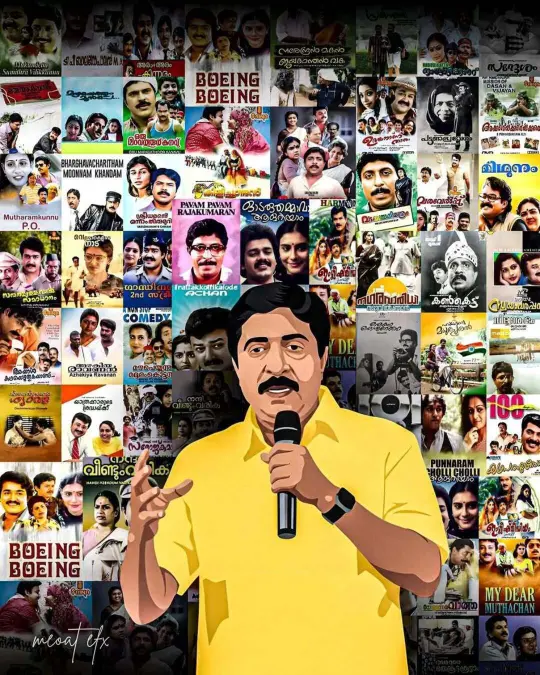
Life experiences have always inspired art, blending imagination, wonder, and human struggles. Sreenivasan’s films exemplify this: rather than dwelling on cruelty or inhumanity, he portrayed harsh social realities through humor, turning them into pointed commentaries on corrupt politicians and officials. Films like Vellanakalude Naadu and Varavelpu illustrate how bureaucrats, politicians, and trade unions often obstruct the growth of enterprises, while protagonists striving to start ventures are met with endless hurdles.
Authority and those wielding it were often central to Sreenivasan’s storytelling. Even when interpreted as apolitical, his films exposed the hypocrisy of power and foregrounded the realities of common life. Characters such as self-serving politicians became objects of satire. At a time when “development” became a political slogan and a path to power, Sreenivasan’s films bravely revealed the corruption and self-interest lurking behind these façades.
Another recurring theme in his work was unemployment, which hindered development. Protagonists in films like Gandhinagar 2nd Street, T.P. Balagopalan M.A., and Naadodikkattu represented the struggles of thousands of unemployed youth, while humor remained a constant. Sreenivasan’s unique ability to use comedy as a tool for social satire allowed him to deliver thought-provoking messages even amid laughter. He proved that cinema is not mere entertainment but a powerful medium to engage society.
Even today, the questions his films raised, about development, politics, and corruption, remain relevant. Sreenivasan’s movies serve as enduring mirrors, reflecting society’s truths and holding them up for Malayalam audiences to examine, ensuring his legacy of socially conscious cinema remains timeless.
