


Adani Airports anticipates handling 120 million passengers across its eight airports next year, including the soon-to-be-operational Navi Mumbai International Airport, a senior official said.
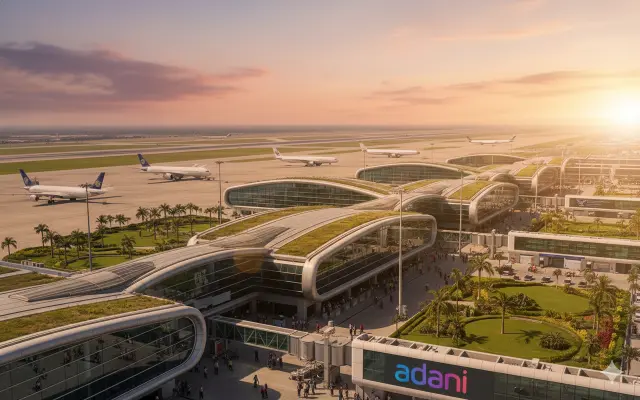
Speaking to PTI ahead of Navi Mumbai airport’s commercial launch on December 25, Adani Airport Holdings Ltd (AAHL) Director Jeet Adani emphasized that the company’s focus remains on domestic growth, with no immediate plans to acquire overseas assets.
“Last year, we handled around 89-90 million passengers across our seven airports. This year, we are likely to reach about 100 million,” Adani noted. With the addition of Navi Mumbai airport, he expects total traffic next year to rise to 120 million.
Currently, AAHL operates seven airports: Mumbai, Ahmedabad, Thiruvananthapuram, Jaipur, Lucknow, Guwahati, and Mangalore. Navi Mumbai International Airport, inaugurated by Prime Minister Narendra Modi in October, will be the company’s eighth.
The greenfield airport, the second in the Mumbai Metropolitan Region after Chhatrapati Shivaji Maharaj International Airport, is being developed in phases by NMIAL, where Adani Group holds a 74% stake and Maharashtra government agency CIDCO holds 26%. Spread over 1,160 hectares, the airport will ultimately feature four terminals with the capacity to handle 90 million passengers annually and a cargo capacity of 3.25 million metric tonnes, making it one of Asia’s largest aviation hubs.
Adani described the airport as “a significant asset” for AAHL, projecting that when it reaches full capacity, the group could serve more than 500 million passengers annually across all its airports. He added that India’s aviation market is growing rapidly, with passenger traffic expanding at mid-teen to double-digit rates annually. The primary challenge, he noted, is a supply constraint in terms of new aircraft, although early signs suggest improvement.
Highlighting its modern design, Adani said Navi Mumbai airport has been planned with the “new age of airports” and the “new age of India” in mind. The first phase will handle 20 million passengers, with the next phase to be launched once the initial phase stabilizes, potentially increasing capacity to 30-50 million passengers.
Adani also stressed that the airport’s infrastructure and technology are built from the ground up. A proprietary database and workflow management platform allow passengers to access real-time information with the same accuracy as airport operators in the Airport Operations Control Centre (AOCC).
He concluded that the airport, along with the three additional terminals planned, is designed to position Navi Mumbai as a global aviation hub for Indian airlines.
