


The Adani Group is set to invest Rs 1 lakh crore in its airports business over the next five years, capitalizing on sustained growth in India’s aviation sector, which is projected to expand at 15-16% annually, a senior company official said.
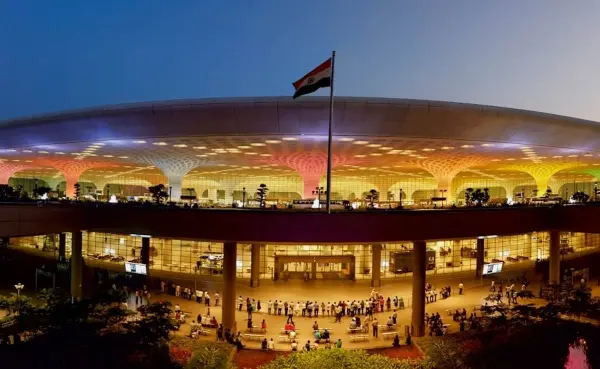
Navi Mumbai Airport: A Landmark Launch
Jeet Adani, Director of Adani Airports and younger son of billionaire Gautam Adani, said the investment plan was announced ahead of the commercial operations at Navi Mumbai International Airport, scheduled to begin on December 25. The airport, developed by Navi Mumbai International Airport Ltd (NMIAL) in which Adani Group holds a 74% stake, marks the latest addition to the group’s growing portfolio.
Built at an initial cost of Rs 19,650 crore, the first phase will handle 20 million passengers annually, with future plans to scale up to 90 million, addressing capacity constraints at Mumbai’s Chhatrapati Shivaji Maharaj International Airport and supporting long-term regional air traffic growth.
Expanding Airport Portfolio
Alongside Mumbai, the Adani Group operates six other airports in Ahmedabad, Lucknow, Guwahati, Thiruvananthapuram, Jaipur, and Mangaluru, covering a mix of metro and regional hubs. The group also plans to bid aggressively in the next round of airport privatisations.
“As a staunch believer in this industry, we will be very aggressive in the next round of bidding for all 11 airports,” Jeet Adani said.
Future Investments in MRO and Flight Training
On the MRO (Maintenance, Repair & Overhaul) and Flight Simulation Training Centre (FSTC) verticals, he said strategy finalization is ongoing but emphasized the group’s commitment to expanding expertise and depth in aircraft services.
India’s Aviation Growth Potential
Adani highlighted that India’s aviation sector, encompassing airports and airlines, could sustain mid-teens growth for the next decade or more. “Even at China-level air travel per capita, the sector would have to grow across multiple cities,” he said, describing the sector’s expansion runway as long-term and robust.
Capacity Relief for Mumbai
The launch of Navi Mumbai Airport will relieve pressure on Mumbai’s existing airport, which has been supply constrained since 2016. “With the start of Navi Mumbai Airport, we will finally see some relaxation there,” Adani noted.
Transforming Airport Operations
Adani Airport Holdings Ltd (AAHL), the group’s airport arm, is India’s largest airport infrastructure operator, handling roughly 23% of passenger traffic and 33% of cargo traffic nationally. The group is also investing in phased capacity upgrades, non-aeronautical retail, and city-side developments to diversify revenue streams.
“We have separated the airport infrastructure business from aircraft services, including dual-use for defence and civilian operations,” Adani said.
Previous Acquisitions and Future Plans
In the 2019 privatisation round, Adani Group won six airports—Ahmedabad, Lucknow, Guwahati, Thiruvananthapuram, Jaipur, and Mangaluru—and acquired Mumbai Airport from GVK Group in 2021. The Civil Aviation Ministry has identified 11 airports for operations under the public-private partnership model, while the National Monetisation Pipeline envisages leasing 25 AAI-operated airports between 2022 and 2025.
