


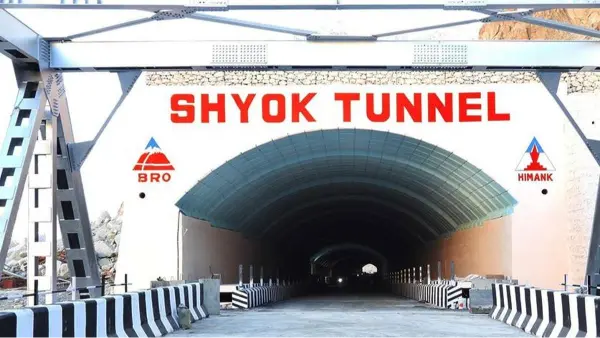
Defence Minister Rajnath Singh recently inaugurated the Shyok Tunnel on the Durbuk-Shyok-Daulat Beg Oldie (DS-DBO) road in eastern Ladakh, part of 125 infrastructure projects by the Border Roads Organisation (BRO). Singh described the 920-metre cut-and-cover tunnel as an “engineering marvel,” highlighting its role in providing all-weather connectivity to this strategically vital region along the Line of Actual Control (LAC).
The Shyok Tunnel, on the 255 km DS-DBO road—the only operational route linking Durbuk to the Depsang Plains and DBO—will enhance troop mobility, rapid deployment, and security, especially during harsh winters when heavy snowfall and avalanches often disrupt travel. The tunnel also benefits local border populations by improving access to the hinterland and reduces reliance on air supply for military logistics.
An alternative road to DBO is being developed via Sassoma, connecting the Nubra River to Sasser La and Gapshan, expected to be operational next year. The Depsang Plains, a historic friction point with China, saw troop disengagement in October 2024 following earlier standoffs.
Since the Galwan Valley clashes in 2020, India has accelerated infrastructure in Ladakh, building new roads, tracks, tunnels, and bridges capable of supporting heavy military equipment. Other developments include upgraded helipads, advanced landing grounds, logistics bases, underground shelters, secure supply chains, and habitats for troops stationed near the LAC. The Nyoma airbase, operational this month, can accommodate fighters, transport aircraft, and helicopters close to the China border.
The BRO spent Rs 16,690 crore on border infrastructure in 2024-25, with a target of Rs 18,700 crore for 2025-26, underscoring India’s ongoing investment in strategic connectivity and military preparedness in eastern Ladakh.
