


The government reported that freight loading on Indian Railways rose from 1,233 million tonnes (MT) in 2020-21 to 1,617 MT in 2024-25, making it the second-largest freight-carrying railway network in the world.
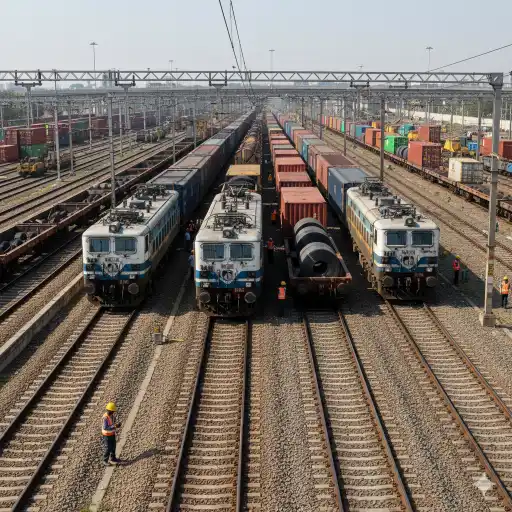
Union Minister Ashwini Vaishnaw noted that freight rates have remained unchanged since 2018 despite rising input costs, keeping transport rates competitive.
Passenger fares, on the other hand, were revised from July 1, 2025, for the first time in over five years, with minimal increases ranging from half a paisa to two paise per kilometer for premium classes. Measures to ensure affordable travel include: no increase for general class up to 500 km, half-paisa increase per km in Sleeper and First-Class Ordinary, one paisa per km for Non-AC Mail Express, and two paise per km for reserved AC classes. Monthly Season Tickets and suburban fares have not been revised to support low- and middle-income commuters.
To boost freight loading and revenue, Indian Railways has undertaken extensive network expansion through new line construction, multi-tracking, and gauge conversion. As of April 1, 2025, 431 projects have been sanctioned, including 154 new lines, 33 gauge conversions, and 244 doubling projects.
Electrification of railway lines has been pursued aggressively, with about 99.1% of the Broad Gauge network now electrified. Freight capacity has also been increased by procuring approximately 200,000 wagons and adding over 10,000 locomotives between 2014 and 2025, enhancing both freight loading and mobility.
