


India is stepping into a new era of missile warfare with the planned first flight test of BrahMos-II, its next-generation hypersonic cruise missile, targeted for 2027–28. The project is being developed under the BrahMos Aerospace framework with the involvement of the Defence Research and Development Organisation (DRDO), and is seen as one of the country’s most ambitious defence technology programmes.
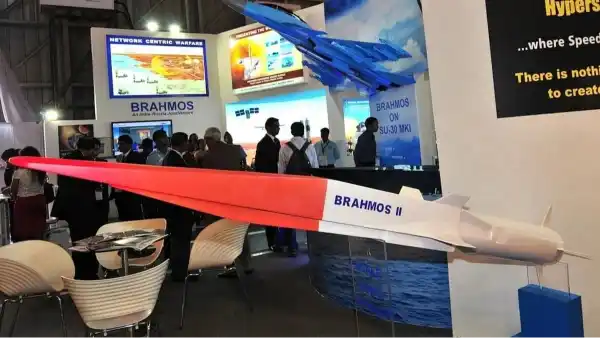
Unlike the current BrahMos supersonic missile, BrahMos-II is designed to operate at hypersonic speeds, reportedly between Mach 6 and Mach 8. At these velocities, the missile would be capable of penetrating even the most advanced air-defence systems, drastically reducing the reaction time available to enemy radars and interceptors. This capability is expected to transform India’s precision-strike and deterrence posture.
A central feature of BrahMos-II is its scramjet (supersonic combustion ramjet) engine. DRDO has already completed long-duration ground tests of scramjet combustors, successfully demonstrating sustained hypersonic combustion. These tests are considered a critical technological milestone, as scramjet propulsion is one of the most complex aspects of hypersonic weapon development.
The upcoming flight test will focus on validating multiple high-risk technologies, including high-temperature resistant materials, thermal protection systems, hypersonic guidance and navigation, and stable propulsion performance at extreme speeds. Engineers are also working on ensuring structural stability and accuracy under the intense aerodynamic and thermal loads experienced during hypersonic flight.
In the long term, BrahMos-II is expected to be adaptable across multiple launch platforms. These include mobile land-based launchers, naval warships, submarines, and potentially air-launched versions for fighter aircraft. This tri-service capability would allow the Indian armed forces to deploy the missile with maximum operational flexibility across land and maritime theatres.
Strategically, the BrahMos-II programme positions India among a small group of nations developing operational hypersonic weapons. As global military powers increasingly focus on hypersonic capabilities, this project is viewed as a crucial step in maintaining credible deterrence and strengthening national security. Once operational, BrahMos-II is expected to play a key role in India’s future warfare doctrine, offering unmatched speed, precision, and survivability.
