


Donald Trump’s second term has created a complicated reality for Indians seeking work, study, or long-term residence in the United States. While his administration claims to want high-skilled workers for strategic sectors, policy changes in 2024 and 2025 have introduced new hurdles, particularly for those waiting in long green-card queues. The approach appears selective: opportunities open when talent serves U.S. priorities, but restrictions tighten otherwise.
When tech talent is needed, Trump has been vocal. At the U.S.–Saudi Investment Forum on November 19, 2025, he told business leaders that companies investing in semiconductor factories cannot hire “people off an unemployment line” to run them. He encouraged firms to bring specialists who can train U.S. workers in making chips and other technologies, acknowledging political pushback but emphasizing the economic necessity. Earlier, in June 2024 on the All-In Podcast, he suggested that graduates of U.S. universities should automatically receive green cards, highlighting support for merit-based, targeted immigration—a pathway dominated by Indian talent.
Yet the rules for many Indians have been tightening. A new $100,000 entry fee for H-1B workers from abroad raises costs for employers, while revised wage requirements and narrower specialty-occupation definitions make qualification harder. Automatic work-permit extensions for H-4 spouses ended on October 30, affecting thousands, mostly Indian women. Increased scrutiny at ports of entry and shifting visa rules have added uncertainty for families.
Data from the National Foundation for American Policy for FY 2025 shows the changing landscape. Amazon led new H-1B approvals with 4,644, followed by Meta, Microsoft, and Google—the first time U.S. tech companies filled the top four slots. Indian IT firms saw sharp declines: TCS had 846 approvals, LTIMindtree 401, and HCL America 379. Top seven Indian employers together received 4,573 approvals, a 70 percent drop since 2015.
Employers filed over 114,000 petitions for new H-1Bs and nearly 292,000 for continuing employment. Denial rates rose slightly to 2.8 percent. Sponsorship costs now reach $34,900, or nearly $50,000 including green-card processing. H-1B workers remain highly skilled, with an average computer occupation salary of $136,000 and 63 percent holding advanced degrees.
International students face uncertainty too. A new Department of Homeland Security proposal could limit or end the Optional Practical Training (OPT) program, which allows graduates to work in their field for up to three years with a STEM extension. Nearly 250,000 students rely on OPT annually, many of them Indians, as a bridge to the H-1B system. Other moves, like shorter student admission periods and prioritizing senior workers in H-1B selection, add to the unpredictability.
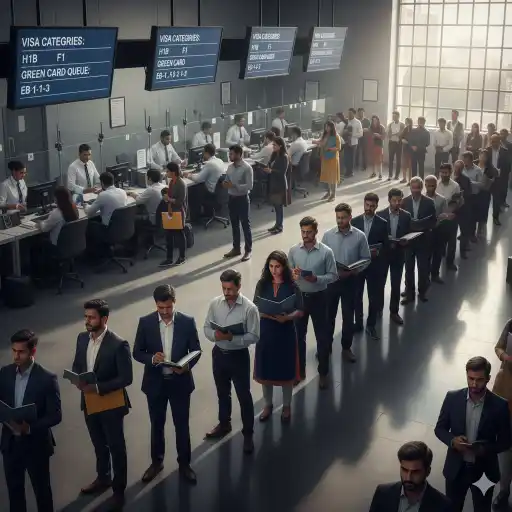
Green-card backlogs are another challenge. Over 1.2 million Indian professionals are stuck in employment-based queues, with some EB-2 categories facing waits of two decades or more due to country caps and slow priority-date movement. These delays also affect families: roughly 134,000 Indian children on H-4 visas may lose dependent status at 21, even after years in the U.S.
Trump’s policies have also changed birthright citizenship. An executive order limits automatic citizenship for children born in the U.S. if the mother was in the country unlawfully or on a temporary visa and the father was not a citizen or permanent resident. For Indian families on temporary visas, this creates new uncertainty, as a child’s status now depends on the parents’ visa category.
Research shows the U.S. economy benefits from skilled immigrants. The American Immigration Council’s 2025 analysis finds that foreign-born professionals strengthen the labor force, support key industries, and contribute to growth. Columbia Business School research also shows high-skilled immigrants drive innovation, create companies, and expand employment without displacing U.S.-born workers, particularly in AI, software, and advanced manufacturing.
Despite this, Trump’s second-term policies increase uncertainty for Indian professionals. Families face higher costs, narrower pathways, and longer waits, creating a conditional welcome: Indian talent is valued when it serves U.S. economic goals but encounters obstacles when seeking long-term stability.
