


Vizhinjam International Seaport, developed by Adani Ports and Special Economic Zone in partnership with the Government of Kerala, has completed its first year of commercial operations with results that have caught the attention of the entire maritime world. In a span of just twelve months, the port has carved out a reputation as one of India’s most advanced deep-water gateways, earning the tag Wonder Port of India for the pace at which it has scaled up and the records it has set.
What stands out is how quickly Vizhinjam has matched global performance standards. It became the fastest Indian port to cross the one-million-TEU mark, hitting that milestone in record time and crossing its annual one-million-TEU capacity within just ten months. By the end of its first year, it had handled 615 vessels and 1.32 million TEUs — numbers usually associated with long-established global hubs.
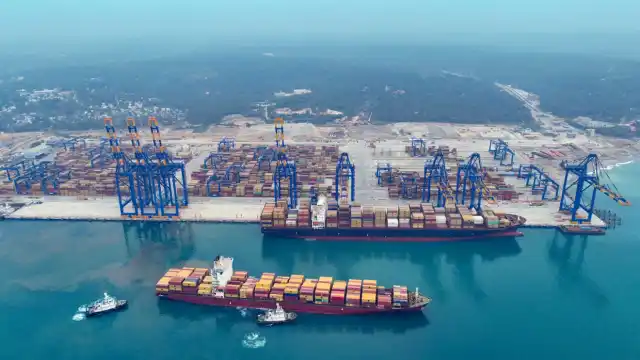
The port’s ability to take on the world’s largest container ships has been central to its rise. Between December 2024 and December 2025, Vizhinjam received 41 ultra-large container vessels, each measuring more than 399 metres, the highest count for any Indian port. It also handled 154 ships longer than 300 metres and recorded 45 arrivals with drafts above 16 metres, showcasing the advantage of its natural depth. MSC Verona arrived with a draft of 17.1 metres, the deepest ever handled in South Asia, while MSC Irina — the world’s largest container ship — also called during the year. MSC Paloma brought in the highest TEU load recorded at the port with 10,576 TEUs. October 2025 saw the port post a gross crane rate of 28.52, another standout figure.
Much of this momentum is driven by technology and design choices that make Vizhinjam one of India’s most modern maritime facilities. It is the country’s first semi-automated container port, bringing greater speed and reliability to operations. It is also the first to place women in automated crane operator roles, marking a quiet but meaningful shift in a male-dominated sector. The port uses home-grown technology for its Vehicle Traffic Management System, which has played a big role in improving landside turnaround times.
The engineering behind the port matches the scale of its operations. A three-kilometre breakwater — 28 metres tall and 125 metres wide — shields the harbour, while the natural depth of 18 to 20 metres allows the biggest vessels to berth without extensive dredging. Minimal littoral drift ensures that operations remain stable through the year.
Vizhinjam’s location near the busy East–West shipping route has strengthened its emergence as a strategic gateway for global trade. With the capacity to handle the world’s largest carriers and the speed to move cargo at international benchmarks, the port is steadily positioning itself as India’s premier deep-water transshipment hub — and its first year suggests it is only getting started.
